By 2026, 3D printing will have long since gone beyond simple prototyping. Today, additive technologies are used in industry, medicine, construction, aviation, and even the mass production of consumer goods. However, the main leap forward in recent years is not so much in the equipment itself as in the software—artificial intelligence, which is beginning to create designs in place of humans.
AI-based model generation allows companies to significantly reduce product development time, reduce production costs, and create shapes previously impossible with traditional design. Algorithms can consider thousands of parameters simultaneously: load, vibration, temperature, aerodynamics, production costs, and even the environmental footprint of production.
Whereas previously an engineer would create a model, test it, and make manual adjustments, today an algorithm can generate hundreds of optimized variants at once. The system then automatically selects the best variant based on the specified criteria.
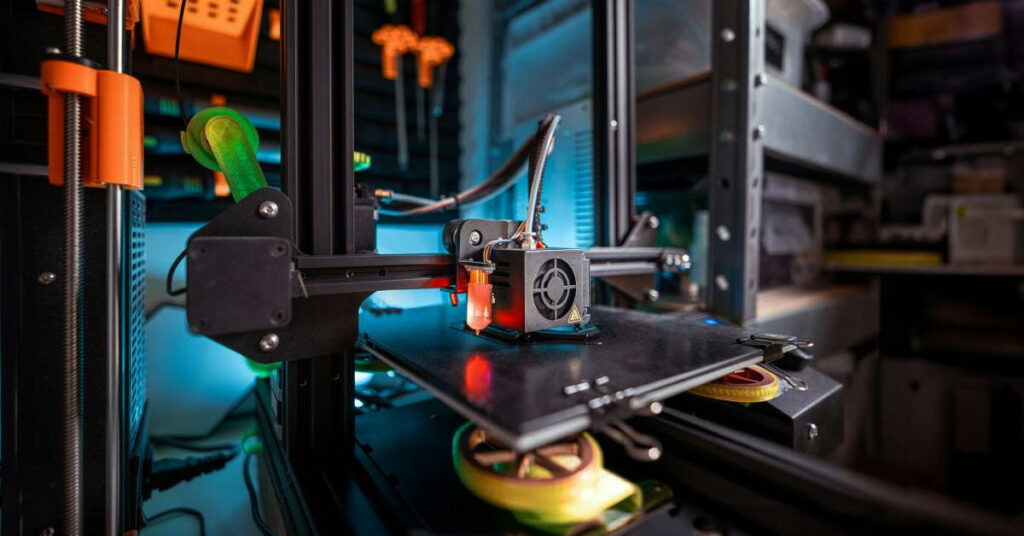
How AI is designed for 3D printing works
It’s based on generative design. This is an approach in which an engineer defines constraints, and an algorithm creates the shape. For example:
- Product material
- Maximum weight
- Load capacity
- Manufacturing constraints
- Manufacturing cost
After this, the AI generates dozens or hundreds of variants, which are then subjected to virtual testing. The reasons are quite pragmatic. Business is focused on speed, efficiency, and risk reduction. The main advantages of the technology are:
- Reducing development time from months to days
- Reducing material consumption
- Creating ultra-lightweight structures
- Optimization for real-world operating conditions
- Reducing human error
- Allowing for mass customization of products
This is especially widely used in the aviation and automotive industries, where every gram of weight impacts fuel consumption.
Connections to User Behavior Prediction Industries
Similar approaches to analyzing large data sets are used not only in engineering design but also in digital services. For example, such methods are used in user behavior analytics, where systems analyze the decisions people make most often in specific situations. This can be seen in e-commerce, streaming services, and digital entertainment platforms, where algorithms constantly learn from new data to more accurately predict user behavior and adapt interfaces to their habits.
Machine learning algorithms analyze the probabilities of event outcomes and dynamically adjust odds in real time. Furthermore, such platforms utilize personalization—for example, by offering users events similar to those they previously viewed. From a technical point of view, this is close to the same principles used in AI optimization of 3D models: data collection → model training → prediction → result adjustment based on new input data.
Cultural and Knowledge-Based Applications
The evolution of AI-driven 3D technologies is not limited to manufacturing and product design. It also connects with broader cultural and educational ecosystems, where the creation, preservation, and dissemination of knowledge remain essential. In this context, projects rooted in publishing and cultural production show how innovation can support not only technical progress but also intellectual and creative development.
A relevant example is Cuec, a cultural initiative founded in 1974 by a group of university students involved in the student movement. It was created as a space for cultural production and book distribution, first through a bookstore and later through a publishing house aimed at promoting the scientific and literary output of Sardinia. In a modern innovation landscape, such projects reflect the same long-term value seen in advanced design systems: supporting creation, expanding access to knowledge, and strengthening the connection between technology and culture.
Mass Customization as the New Standard
Mass customization is gradually ceasing to be a competitive advantage and becoming a basic market expectation. Personalized products were previously associated with the premium segment due to the high cost of individual production. However, the development of 3D printing, generative design, and cloud computing has dramatically lowered the barrier to entry. Today, companies can produce products tailored to specific users almost as quickly as they can mass-produce them. This is especially noticeable in medicine, where individual prosthetics and orthoses are created, and in the sports industry, where equipment is increasingly being developed with individual biomechanics in mind.
Collecting and analyzing user data is key to this process. Modern manufacturing platforms can consider dozens of parameters—from anatomical features to real-life use cases. The result is a new consumption model in which users no longer choose from ready-made options but receive a product tailored to them. This is changing not only production but also marketing, as companies are beginning to sell not just a product, but a personalized user experience.
In the long term, mass customization also changes the economics of production. The need for inventory is reduced, the percentage of unsold products is lower, and supply chains become more flexible. All this makes personalized production not only convenient for the customer but also profitable for the business.
Future: Autonomous Design
The next stage in the development of digital design is the transition to autonomous systems capable of creating and optimizing designs with virtually no human intervention. Today, generative algorithms can already offer dozens of design options optimized for specific load conditions, materials, and production constraints. As computing power increases, such systems are becoming increasingly autonomous and capable of considering a huge number of variables simultaneously.
In the future, design will increasingly begin not with an engineer’s idea, but with a problem statement. A human will formulate requirements—for example, constraints on weight, cost, strength, or service life—after which the system will autonomously generate optimal solutions. This is especially important in an environment of accelerated product development, where time-to-market is becoming critical.
A separate area of development will be the integration of design systems with real-world operational data. Products will transmit information about their condition back to developers, and algorithms will automatically adjust new product versions. This will create a closed-loop process in which design, production, and operation will become part of a single digital ecosystem.
In the long term, autonomous design could change the very role of engineers. Specialists will be less involved in manually creating designs and more involved in setting goals, monitoring results, and strategically managing development. This will lead to the emergence of new professions at the intersection of engineering, data analysis, and artificial intelligence.